
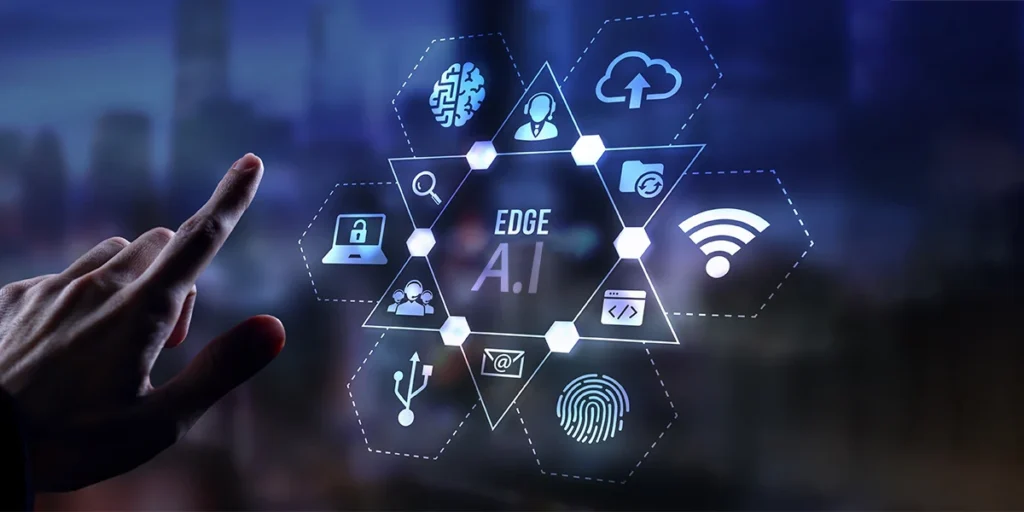
Edge Ai is use of AI algorithms as well as AI models on devices at edge including sensors and Internet of Things (IoT) devices. This allows instantaneous data processing and analysis without need for cloud infrastructure.
In most fundamental terms Edge AI (also known as “AI on edge” is term used to describe use of edge computing with artificial intelligence for performing task based machine learning directly through interconnected devices. Edge computing permits data to be saved near to location of device while AI algorithms permit processing at edge of network regardless of an Internet connection. This enables data processing in milliseconds giving instant feedback.
Autonomous vehicles wearable gadgets as well as security cameras and household appliances are part of technologies which utilize latest AI capabilities to quickly provide customers with up to date information at time they need it most.
Edge AI is becoming popular because companies are finding inventive ways to harness power of Edge AI to improve workflows improve procedures and promote development of new ideas. While doing so Edge AI helps to address crucial issues like security latency as well as cost reduction.
Edge AI versus distributed AI
Edge AI enables onsite decision making which eliminates requirement to continuously transmit data to central server and then wait for processing.. that makes it easier to automate operational processes. But data must be sent to cloud in order to retrain AI pipelines and to deploy updated models.
Implementing this model across many places and different applications can pose problems like homogeneity data density scaling as well as resource restrictions. Distributed AI can help overcome these challenges by integrating smart data collection automating data as well as AI cycles adjusting and monitoring spokes and optimising data as well as AI pipelines.
Distributed artificial Intelligence (DAI) is accountable in distributing coordination and forecasting objective task or decision making performance within an environment of multiagents. DAI expands applications of spokes and allows AI algorithms to process autonomously across various domains systems as well as devices.. that are on edge.
Edge AI versus cloud AI
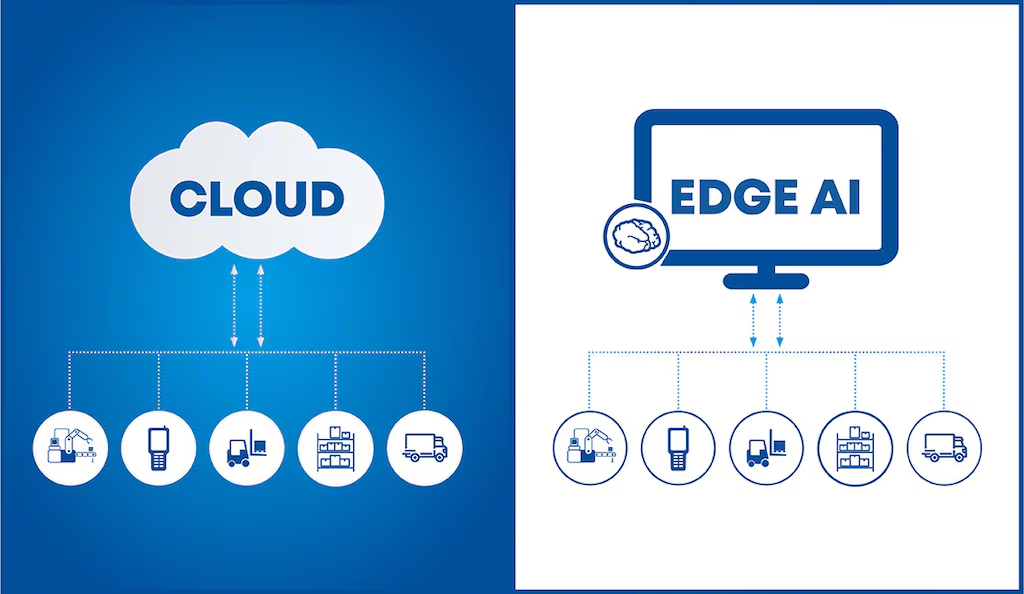
Cloud computing is popular method of computing. applications programming interfaces (APIs) can be utilized for training and deploying model based models for machine learning. Then edge AI executes machine learning tasks like predictive analytics speech recognition anomaly detection near to user.
It differentiates it from other cloud computing services in variety of ways. Instead of apps being created.. that run completely via cloud services edge AI technology analyzes and processes data close to at which it was first created.
Machine learning algorithms can be programmed to operate on edge and data is processed in device IoT devices rather than inside private data center or within cloud computing center.
Edge AI is an alternative when real time predictions and data processing is necessary. Take look at latest advances in technology for self driving cars. In order to ensure safe navigation of these vehicles and also their safety from dangers.. that could arise cars must quickly recognize and adapt to wide range of elements such as traffic signal unpredictable drivers as well as lane change. Furthermore they have to consider pedestrians curbs and many different variables.
Edge AIs capacity to store and process data in vehicle minimizes risk of connectivity issues.. that could result from sending of information to remote servers by cloud based AI. When it comes to situations like this when quick responses to data can determine fate of outcome capability of vehicle to respond quickly is vital.
However cloud AI is use of AI algorithms and models onto cloud servers. Cloud AI provides greater processing and storage capabilities which facilitates development and implementation of most modern AI models.
There are key distinctions between cloud AI and edge AI
Processing power
Cloud AI offers more computational capability and storage capacity than edge AI.. that allows creation and implementation of more complex and sophisticated AI models. Edge AIs processing power is constrained by devices dimensions.
Latency
The impact of latency is directly on efficiency productivity and application efficiency and users experience. greater amount of delay (and slow response times) more those affected areas are. Edge AI provides reduced latency because it processes data within device. In contrast cloud AI is method of transfer of data to remote servers which results in increased amount of latency.
Bandwidth of network
Bandwidth refers transfer of public data networks outbound and inbound worldwide. Edge AI calls for lower bandwidth because of local data processing in device while cloud AI requires transmission of data to remote servers.. that require higher internet bandwidth.
Security
Edge architecture provides enhanced security by processing sensitive information directly within device while cloud AI involves sending information to server outside of device and exposing sensitive data to servers of third parties.
Advantages of edge AI to consumers
The market for 2022s global edge AI market had value of USD 14787.5 million and it will likely to reach USD 66.47 million before 2023s date in accordance with study produced by Grand View Research Inc. Growing need for edge computing based on IoT services in conjunction with its inherent advantages of edge computing will drive rapid growth for edge computing. main benefits of edge AI are:
Diminished latency
With complete processing on device Users can enjoy quick time to response without any lag due to necessity for data to be transferred back from server located far away.
A decrease in bandwidth
Since edge AI handles data on an individual scale it reduces amount of data sent through internet. This leads to reduction in bandwidth of internet. In event.. that less bandwidth is required it allows data connection to cope with greater quantity of simultaneous data transmission and reception.
Analytics in real time
It is possible to do instantaneous data processing without requirement of connection to system or integration with it which allows them to conserve time and effort by combining data without having to connect with physical places. But edge AI could be unable to manage huge volume and variety of data needed by some AI applications. In order to overcome this edge AI must be integrated with cloud computing utilizing its capabilities and resources.
Privacy of your data
Data security is enhanced because it cannot be transferred onto another network where data is more vulnerable to attacks from cybercriminals. By processing data local to device edge AI lowers possibility of improper handling of information.
For industries.. that are.. that are subject to regulations on data sovereignty edge AI assists in ensuring compliance of data sovereignty regulations by processing locally and storing information within specified areas of jurisdiction.
But any database.. that is centralized is prone to becoming tempting target for hackers which means.. that edge AI remains vulnerable to security risk.
Scalability
Edge AI expands systems by using cloud based platforms and built in edge capabilities.. that are inherent to Original Equipment Manufacturer (OEM) technology.. that encompasses hardware as well as software.
This OEM firms have started to include Edge capabilities native to their devices thereby making it simpler to expand systems. expansion allows local networks to function even when some downstream and upstream networks are experiencing interruptions.
Lower costs
The costs associated with AI services.. that are hosted in cloud resources can be costly. Edge AI offers option to use cloud based resources.. that are expensive to serve as storage facility for post processing accumulation of data which is intended for analysis in future rather than immediately field operation. This helps reduce burden on cloud computing and network.
The utilization of CPU GPU and memory is experiencing an enormous reduction in workloads of these devices are spread out between edge devices establishing edge AI as economical option among two.
Cloud computing is able to handle entire computation to provide service central place is major burden. They are hit with high volumes of traffic as they transfer data back to central location. When machines complete jobs networks get operational again transferring information back to user.
Edge devices stop this continual exchange of data. This means.. that machines and networks experience lower stress levels when theyre free of stress to manage every element.
Furthermore autonomy features.. that are inherent in edge AI remove requirement for constant supervision from data scientists. While human interpretation plays an important part in determining final worth of data as well as results it produces and results it produces edge AI platforms take on portion part of this burden. This leads to reductions in costs for companies.
How do cutting edge AI technology function?
Edge AI uses neural networks and deep learning in order to create models.. that can accurately identify how to classify describe and categorize objects.. that are contained in dataset. This process typically involves an centralized data center or cloud for processing huge amount of data needed to train models.
After deployment edge AI models progressively improve over time. In event.. that AI detects glitch it will be able to fix issue. data.. that is problematic typically gets transferred to cloud to continue training first AI model. This eventually is replaced by inference engine on edge. This feedback loop greatly contributes in enhancing performance of models.
Edge AI use cases by industry
Today most common applications of edge AI are phones wearable devices to monitor health (for instance. Smart watches for example.) and real time updates on traffic in autonomous vehicles linked devices and intelligent appliances.
Many industries are increasingly using edge AI applications to lower expenses streamline procedures enhance decision making processes and enhance operations.
Healthcare
Healthcare facilities are going through an enormous transformation due to implementation of cutting edge AI as well as development of cutting edge devices. In conjunction with other edge developments this technology could lead to development of better healthcare facilities and at same time protect privacy of patient and cutting down on time to respond.
With help of AI models embedded locally wearable health monitors analyze metrics including heart rate or blood pressure levels as well as respiration. Wearable edge AI devices also can identify when someone has sudden fall and warn caregivers which is feature thats already available in majority of smartwatches available.. that are available.
By equipping emergency vehicles with speedy data processing capability Paramedics are able to gain insights from health monitoring devices and work with doctors for effective stabilization techniques.
Additionally emergency room personnel are able to prepare for patients specific requirements for care. use of cutting edge AI to address these issues can in exchange of real time vital health data.
Manufacturing
Manufacturers across world have started to implement use of cutting edge AI technology in order to transform way they manufacture which leads to improved efficiency and increased production efficiency.
The data from sensors can be used to detect anomalies in real time and predict machine malfunctions often referred to in field of predictive maintenance.
Sensors on equipment detect imperfections and immediately notify management of important repairs providing prompt resolution while avoiding operational downtime.
Edge AI can also be utilized in different areas.. that are in need of attention within this field like control of quality worker safety and yield optimization supply chain analytics as well as floor optimization.
Retail
Businesses are experiencing huge change due to growing popularization of online shopping. Retail stores.. that are traditionally brick and mortar are being forced to think outside box so.. that they can provide an effortless shopping experience as well as attract customers.
As result new technology has emerged including “pick and go” stores smart shopping carts equipped with sensors and smart checkouts. These new solutions make use of cutting edge AI technology to enhance and improve efficiency of customers traditional shopping customer experience.
Smart homes
The present landscape is filled in “smart” devices such as refrigerators doorbells thermostats as well as entertainment systems and lighting bulbs. Smart homes are equipped with devices.. that utilize edge AI to improve quality of lives of their residents.
When homeowner requires to recognize someone who is at their front door or manage temperature of their home using device they use Edge technology is able to quickly manage data locally. This method eliminates requirement to send data to remote central server. This helps to protect privacy of individual and minimizes chance of an unauthorized access to personal information.
Security and surveillance
The speed of your computer is crucial in security video analysis. lot of computer vision equipments do not possess required speed for analysis in real time. Instead of processing local images and videos.. that are captured of security cameras these devices transfer them to cloud based computer with powerful processing capabilities. In absence of processing information locally cloud based devices face challenges caused by latency issues. which are characterized by slow upload process and data processing.
Edge AIs Computer Vision apps and ability to detect objects in smart security devices detect suspect activity informs user and activates alarms. capabilities give residents an increased sense of security and tranquility.
Benefits and Real World Applications of Edge AI
Edge AI brings range of advantages.. that are changing businesses and improving everyday experiences. Through processing local data Edge AI enables several important advantages:
- Low Latency Decision Making These devices are able to respond to events.. that occur.. that is essential for applications.. that require quick response such as autonomous automobiles industrial automation and augmented reality.
- Reducing Bandwidth Usage Only most relevant information or data compressed are transmitted to cloud. This decreases amount of network traffic and reduces operating costs.
- enhanced security and privacy: Sensitive data remains in device which reduces chance of data attacks during transmission while also assisting companies comply with privacy laws.
- Better Reliability and Availability: Edge AI systems remain operational regardless of internet connectivity being inaccessible or unreliable making systems suitable for mission critical and remote deployments.
- energy efficiency: Software and hardware.. that are optimized can help prolong battery life for remote and portable devices.
- Personalization as well As Context Awareness These devices are able to adapt their behaviour to individual user and their specific environment providing most relevant and timely experience.